Watch Design Parameters Explained: Dial, Lugs, Hands, Numerals & Proportions
Watch design becomes much easier to understand once you know which details control appearance, fit and readability. This guide explains the main visual and dimensional parameters with simple illustrations and practical examples.
1. Start with the basic anatomy of a watch
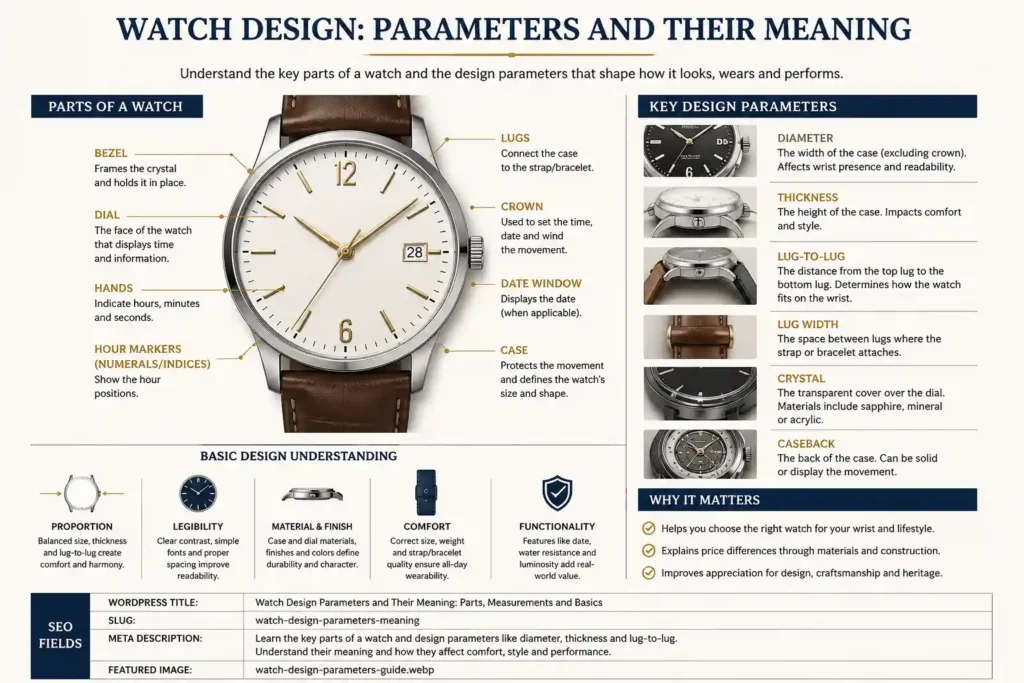
Most watch designs can be understood by separating the watch into a few major areas: the case, the dial, the display elements, the attachment to the wrist, and the watch’s proportions. A change to any one of them can make the same basic watch feel dressier, sportier, more technical or more minimal.
Case, bezel and crown
The case gives the watch its overall body. The bezel frames the crystal and dial, while the crown is the main control used for winding and setting.
Dial, hands and hour markers
Hands and markers determine much of the dial’s character. Batons feel clean and modern; Arabic or Roman numerals add a stronger visual identity.
Lugs and lug shape
Lugs connect the case to the strap or bracelet. Their length, angle and curvature can make a watch wear much smaller or larger than case diameter alone suggests.
Numerals, indices and dial language
Indices are usually cleaner and more technical. Arabic numerals often increase immediacy and legibility, while Roman numerals are strongly associated with traditional and dress-oriented design.
2. The most important watch design parameters
| Parameter | What it changes | What to notice |
|---|---|---|
| Case shape | The overall silhouette. | Round, rectangular, square, tonneau, cushion or more angular forms. |
| Case diameter | Visual presence across the wrist. | Measured across the case, normally excluding the crown. |
| Lug-to-lug | How much wrist length the watch occupies. | Often more important than diameter for whether a watch overhangs the wrist. |
| Thickness | Side profile and comfort under a cuff. | Thin watches can feel dressier; thicker cases often feel more substantial or technical. |
| Lug width | Visual balance between case and strap. | Affects compatible strap or bracelet width. |
| Bezel | How large the dial appears and how sporty the watch feels. | Thin polished bezel, broad fixed bezel, timing bezel or more architectural forms. |
| Dial colour & finish | Mood, contrast and perceived formality. | Matte, sunburst, glossy, textured, metallic or enamel-like surfaces. |
| Hour markers | Readability and visual style. | Applied indices, printed markers, Arabic numerals, Roman numerals or mixed layouts. |
| Hands | Legibility and character. | Stick, baton, dauphine, sword, cathedral, leaf and other shapes. |
| Complications | Information density and dial balance. | Date, day, chronograph, GMT, power reserve, moon phase and other displays. |
| Strap / bracelet | Comfort and the final visual character. | Leather, fabric, rubber or metal can dramatically change the same case design. |
3. Dial design: more than just colour
The dial is the visual centre of a watch. Its design comes from the combination of colour, finish, marker style, typography, hand shape and the amount of information shown.
- Baton indices: clean, modern and easy to scan.
- Arabic numerals: strong legibility and a more direct visual language.
- Roman numerals: traditional and often more formal.
- Mixed markers: combine numerals and indices for a distinctive layout.
- Minimal dial: fewer elements, more visual calm.
- Technical dial: more scales, subdials or information.
4. Lugs: a small detail with a large effect
Lugs are the projections that hold the strap or bracelet. Straight lugs can create a longer, more architectural appearance. Downturned or curved lugs often help a watch hug the wrist. Integrated designs visually merge the case and bracelet, creating a more continuous shape.
When comparing fit, look at lug-to-lug length together with diameter. A moderate-diameter watch with very long lugs can wear larger than expected, while a slightly wider watch with short curved lugs can wear more compactly.
5. Hands, numerals and indices define the personality
Hands and hour markers are functional first, but they also communicate style. Broad luminous hands tend to look sporty. Fine polished hands feel lighter and more formal. Likewise, large Arabic numerals can make a dial feel functional and immediate, while slender applied indices can make the same basic layout appear more refined.
| Design choice | Typical visual effect |
|---|---|
| Thin baton hands + simple indices | Minimal, modern, restrained |
| Dauphine / leaf hands + applied markers | Elegant, dress-oriented, refined |
| Broad luminous hands + bold indices | Sporty, highly legible, functional |
| Arabic numerals | Direct, readable, often casual or instrument-like |
| Roman numerals | Traditional, classical, often formal |
6. Proportion: why specifications alone are not enough
Good watch design depends on proportion. Diameter, thickness, bezel width, dial opening, lug length and strap width must work together. This is why two watches listed at the same diameter can look and feel completely different on the wrist.
7. Style families are combinations, not strict rules
Design categories such as dress, field, dive, pilot, racing and integrated-bracelet sports watches are useful because they group recurring design ideas. They are not absolute rules. A modern watch can combine a dress-style dial with a sportier case, or a technical bezel with a refined bracelet.
- Dress: restrained dial, slimmer case, cleaner bezel, elegant hands and markers.
- Field: strong legibility, practical numerals or indices, straightforward case design.
- Dive: prominent timing bezel, luminous display, robust case and sport-oriented strap or bracelet.
- Pilot: high contrast, large numerals and strong minute/hour readability.
- Integrated sports: case, lugs and bracelet designed as one continuous visual form.
8. How to use these parameters when choosing a watch
Instead of asking only whether a watch is “beautiful,” break the design into individual parameters. Decide which case shape, size, lug style, dial, marker type, hands and strap you prefer. This makes comparisons more objective and helps explain why one watch feels right while another does not.
You can use the same logic in our Design Your Watch tool to explore combinations, then move to the Compare Watches page to compare real watches side by side.